The Conversation I Keep Having in the Suite
A patient sat across from me last week and said something I’ve heard at least a dozen times this spring: “I’m doing everything right, and I’m still tired.” She was sleeping seven hours. She’d cut back on wine. She walked her dog every morning. And she still felt like she was dragging a parachute through her day.
She’s 43. And after a long conversation, we started talking about something most women don’t get to name out loud until it’s already affecting their work, their patience, and their workouts: perimenopause.
This is the conversation more women in Canyon Lake, Menifee, and Lake Elsinore are starting to have — and I’m glad. Energy crashes in your late 30s and 40s aren’t a personality flaw or a sign you need more coffee. They’re often a signal that hydration, micronutrients, and recovery aren’t keeping up with what your body is quietly working through.
What’s Actually Happening Under the Hood
Perimenopause isn’t an event — it’s a runway. It can start as early as your mid-30s and stretch for ten years or more before menopause itself. During that window, estrogen and progesterone fluctuate (sometimes wildly), and the downstream effects on sleep, mood, body temperature, and energy can sneak up on you slowly enough that you adapt to feeling worse without realizing it.
A few things shift that matter for how you feel day-to-day. Sleep gets lighter and more easily disrupted, which compounds fatigue. Body composition starts to favor fat storage over muscle, even with the same routine. Hydration needs subtly increase as hormonal changes affect thermoregulation — which is exactly why so many of my Canyon Lake patients tell me they feel more wiped out by warm-weather days than they used to. And demands on certain nutrients, especially B vitamins and iron, can quietly outpace what you’re getting from food.
None of this is in your head. And none of it means you’ve “let yourself go.” It means your body is asking for different support than it needed at 28.
Where Hydration Fits In (And Why Coffee Isn’t Cutting It)
Here’s the part I wish someone had told me earlier in my own career: caffeine masks fatigue, but it doesn’t fix the underlying problem. Many of the women I see are running on a low-grade hydration deficit on top of hormonal shifts, and the combination is brutal. Headaches, brain fog, sluggish workouts, and that mid-afternoon “I just need to lie down” feeling are often more about cellular hydration and electrolytes than willpower.
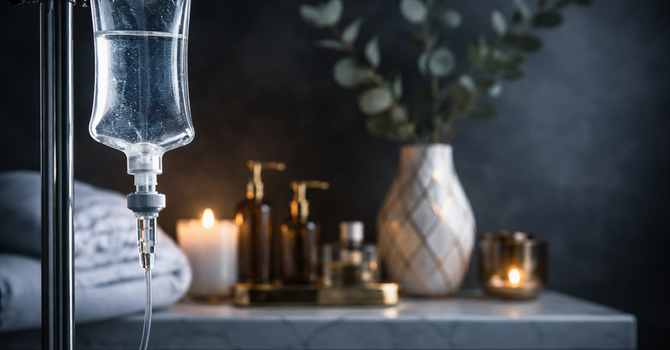
This is one of the reasons our IV therapy menu gets a lot of midlife women — not because IV hydration is a magic fix, but because it delivers fluids and electrolytes in a way that bypasses a digestive system that’s often already on overdrive. A targeted IV with magnesium, B-complex, and amino acids can be a noticeable reset when you’ve been white-knuckling your way through a stretch of bad weeks.
For women who want a more consistent baseline through the year, I usually steer the conversation toward our hydration membership options. A standing monthly drip tends to work better than waiting until you’re crashing — same way you wouldn’t wait until your car is overheating to add coolant.
The B12 Conversation Every Woman Over 35 Should Be Having
If I could put one thing on a billboard at the corner of Railroad Canyon and Goetz, it would be: check your B12 before you assume you’re just tired.
B12 plays a role in red blood cell formation, nerve health, and energy production — and absorption naturally declines with age. Add in years of stress, certain medications (including some used for acid reflux), and the fact that many women in this stage are eating lighter than they used to, and you get a recipe for low energy that doesn’t always show up on a basic lab panel.
This is why wellness injections — particularly B12 and B-complex shots — are one of the most quietly popular services we offer at the suite. They’re quick, they’re affordable, and for women whose energy has been gradually fading for reasons no one has explained, the difference can be meaningful. I always tell patients I’d rather see them ask their primary care provider for a full workup and support their energy in the meantime than spend another six months guessing.
When Weight Becomes Part of the Story
For a lot of women, the perimenopause energy conversation eventually circles back to weight. The same eating habits, the same workouts, and the scale starts moving in the wrong direction. It’s not that you’re doing anything wrong — it’s that the rules quietly changed.
If that’s where you are, our medical weight management program is built for this exact moment. We work with patients on GLP-1 medications when appropriate, but more importantly we treat weight as one signal in a larger picture that includes hydration, micronutrients, sleep, and muscle preservation. The women who do best in midlife are almost always the ones who pair the medication conversation with the recovery conversation — and that’s where IV hydration and B12 support become so useful alongside the weight management plan.
Why I Built Luxe the Way I Did
I spent years in the ER watching how often midlife women’s symptoms got under-investigated or written off. That’s a huge part of why I opened Luxe Wellness inside Wild Blush Suites on Railroad Canyon Road — I wanted a calm, clinically grounded space in Canyon Lake where women could ask the questions they don’t always get to ask in a rushed primary care visit. Everything we do is built around real clinical oversight and a slower pace.
If you’ve been quietly wondering whether something’s off, you’re not imagining it. And you don’t have to figure it out alone — whether you’re driving in from Murrieta, Temecula, Wildomar, or right here in Canyon Lake, we’ll meet you where you are.
Ready to Feel Like Yourself Again?
If this sounds familiar — the fatigue you can’t explain, the workouts that used to feel easier, the hydration that never quite catches up — let’s talk. You can book a visit online any time, or learn more about who we are and how we practice. There’s nothing dramatic about the changes that come with midlife — but the support you give yourself through them can make the next ten years feel a lot more like the ones you actually want.
— Erin Wilcox, RN
Erin Wilcox
Contact Me